Platte County Dog Registration Information
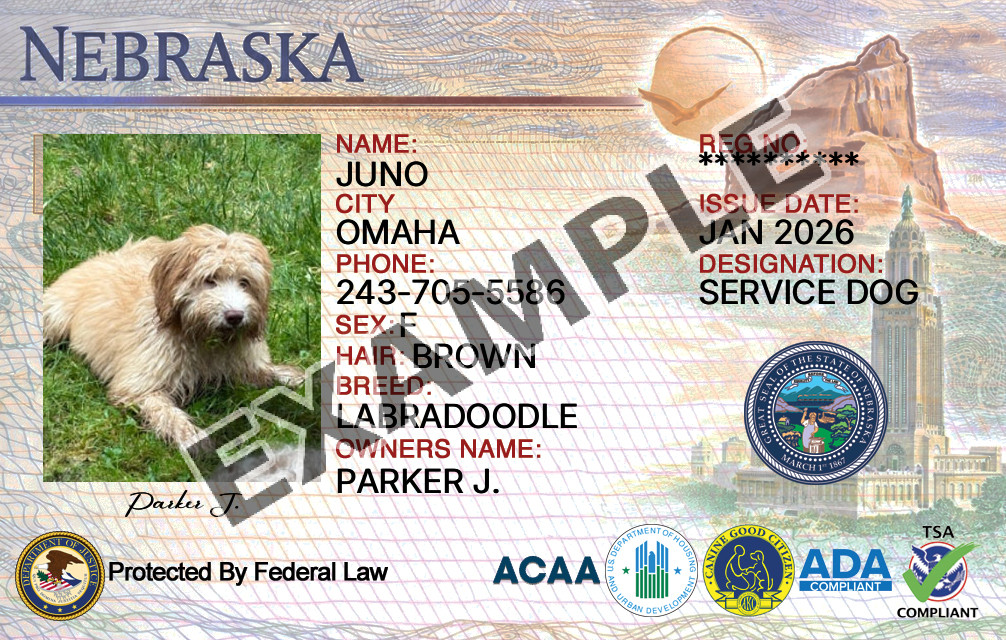
Service Dogs and Emotional Support Animals in Platte, Nebraska
If you’re asking where do I register my dog in Platte County, Nebraska for my service dog or emotional support dog, the key is separating two different ideas: (1) local dog licensing (a city/county requirement tied to rabies vaccination and identification) versus (2) disability-related status (service dog or emotional support animal). In Platte County, dog licensing is typically handled at the local city level (for example, the City of Columbus) and may differ depending on whether you live inside city limits or in an unincorporated area.
- There is no single universal federal “service dog registry” or “emotional support animal registry” used to make a dog a service dog or ESA.
- A dog license in Platte County, Nebraska (or in a city within the county) is a local administrative requirement and commonly requires proof of current rabies vaccination.
- Your “registration” question is usually answered by the office that handles animal control dog license matters where you live (city clerk/animal control), plus any county office that assists residents outside city limits.
Where to Register or License Your Dog in Platte County, Nebraska
The offices below are official government contacts serving Platte County residents. If you’re unsure which office applies to your address (city limits vs. rural/unincorporated), start with the City of Columbus Animal Control for city licensing questions and the Platte County Sheriff’s Office for county-level animal-related issues outside city limits.
Platte County Sheriff’s Office (Platte County, Nebraska)
Use this office as a starting point for animal-related issues in unincorporated Platte County and for guidance on which local jurisdiction handles licensing for your address.
City of Columbus (Nebraska) — Animal Control (Licensing & Information)
This is the primary official contact for where to register a dog in Platte County, Nebraska when you live inside Columbus city limits, and it can also help direct you if your address falls under a different city or village in Platte County. Office hours and email were not verified from official sources available at the time of writing, so they are not listed here.
Overview of Dog Licensing in Platte County, Nebraska
How licensing usually works locally
In Nebraska, dog licensing is commonly handled by the city or village where you live, especially if you live inside incorporated limits (for example, Columbus). That means your “dog registration” is typically the same thing as getting a local dog license and tag.
City vs. county differences inside Platte County
Platte County includes incorporated communities and rural/unincorporated areas. Licensing rules can differ depending on jurisdiction:
- Inside city limits (example: Columbus): licensing and animal control questions are usually handled by the city’s animal control or city clerk process.
- Outside city limits (unincorporated Platte County): animal-related enforcement and guidance may route through the county (often law enforcement), and you may be directed to the appropriate local licensing authority depending on where you reside.
What “registration” means in practice
When people search for “register my dog”, they typically mean one of the following:
- Getting a dog license in Platte County, Nebraska (or in your city within the county)
- Getting a rabies vaccination tag and submitting proof to the licensing office
- Confirming whether a service dog or emotional support dog changes licensing requirements (usually it does not)
What You Need Before Registering a Dog
Common documentation and details
While exact requirements vary by jurisdiction, most local licensing offices in Nebraska typically ask for:
- Proof of current rabies vaccination (rabies certificate from your veterinarian)
- Your name and address (to establish residency in the jurisdiction)
- Basic dog details (breed/type, color/markings, sex, age, identifying features)
- Spay/neuter documentation if your local fee schedule differs for altered vs. unaltered pets
Why rabies documentation matters
Many local ordinances and licensing programs tie licensing to rabies compliance. Practically speaking, licensing offices may:
- Require the rabies certificate before issuing a license tag
- Ask for updated proof at renewal time
- Use licensing records to help reunite lost pets and support animal control administration
Steps to Register or License a Dog in Platte County, Nebraska
Step 1: Confirm your jurisdiction (city limits vs. rural)
Start by confirming whether your home is inside a city/village boundary (such as Columbus). This determines whether your licensing is handled by a city animal control/city clerk process or if you need guidance for an unincorporated area.
Step 2: Contact the appropriate licensing office
- Columbus residents: contact the City of Columbus Animal Control using the phone number listed in the office section above.
- Outside Columbus city limits: contact the Platte County Sheriff’s Office to confirm which local authority handles licensing for your address.
Step 3: Prepare your documents
Gather your rabies certificate and any spay/neuter documentation (if applicable). If you are licensing a newly acquired dog, have acquisition/adoption details available in case they are requested.
Step 4: Submit the application or information requested
The office may handle licensing in-person, by form, or by additional local procedures. Since processes vary, ask what they require for:
- First-time licensing
- Renewals
- Change of address within Platte County
- Replacement tags
Step 5: Keep the tag and records current
Once issued, keep the tag with your dog’s collar (or as required locally) and keep a copy of the rabies certificate for your records. If your dog’s rabies vaccination is updated, be prepared to update the licensing record at renewal or when requested.
Service Dog Laws in Platte County, Nebraska
Service dogs are defined by training and function, not a registry
A service dog is generally a dog that is individually trained to do work or perform tasks for a person with a disability. In everyday terms, a service dog’s legal status comes from the dog’s trained tasks that mitigate a disability—not from buying an ID card or signing up for an online database.
Does a service dog still need a local dog license?
In most jurisdictions, a service dog is still a dog for purposes of local public health and animal control administration. That usually means:
- You may still need to obtain a dog license in Platte County, Nebraska (or your city within the county), just like any other owned dog.
- You should still expect to provide proof of rabies vaccination if your local licensing authority requires it.
- Some jurisdictions may have fee differences or documentation options; ask the licensing office directly what applies in your location.
Public access vs. licensing: two separate topics
Public access rights (where a service dog can go) and local dog licensing requirements are separate. Licensing is a local administrative process; public access is generally governed by disability law standards. A local license tag does not create service dog status, and service dog status does not automatically replace local licensing rules.
| Category | What It Is | Typical “Registration”/Paperwork | Access Rights (General) |
|---|---|---|---|
| Dog License | Local license/tag issued by a city or other local jurisdiction for identification and administrative compliance. | Often requires rabies vaccination proof and owner/dog information; may be renewed periodically. | Not a public-access credential. It does not grant special entry into no-pets areas. |
| Service Dog | A dog individually trained to perform tasks for a person with a disability. | No universal government registry. You may still be expected to meet local licensing and vaccination rules. | Generally allowed to accompany the handler in many public places where pets are not allowed, subject to applicable rules. |
| Emotional Support Animal (ESA) | An animal that provides comfort by its presence and may be part of a treatment plan. | Typically supported by documentation from a healthcare professional for specific situations (commonly housing-related), plus any local dog licensing requirements. | Not the same as a service dog for public access. ESAs are not automatically allowed in all no-pets public places. |
Emotional Support Animal Rules in Platte County, Nebraska
An ESA is not a service dog
An emotional support animal (including an emotional support dog) is not the same as a service dog. ESAs generally do not qualify for the same broad public-access rights as service dogs. People often confuse “registering” an ESA with licensing a dog; in reality, ESA-related documentation is typically separate from your local dog license.
Do ESAs still need local licensing?
In most cases, yes. An ESA is still a dog under local animal control rules, so you should plan on:
- Obtaining the required dog license in Platte County, Nebraska (or in your city within the county)
- Keeping your dog’s rabies vaccination current and available to the licensing office
- Following local leash, at-large, nuisance, and bite-reporting rules, just like any other owned dog
If your question is really about housing
Many ESA questions are housing-related (for example, requesting a reasonable accommodation). That is separate from dog licensing. Even if you have ESA documentation for housing, you may still be expected to comply with local licensing requirements and rabies vaccination rules.
Frequently Asked Questions
What You May Need
Disclaimer
Local laws, fees, office locations, and contact details can change. Residents should verify the most current information with their local animal services or licensing office in Platte County, Nebraska.
- where to register a dog in Platte County, Nebraska
- dog licensing requirements Platte County, Nebraska
- dog license in Platte County, Nebraska
- animal control dog license Platte County, Nebraska
Register A Dog In Other Nebraska Counties
Select your county below to get started with your dog’s ID card. Requirements and license designs may vary by county, so choose your location to see the correct options and complete your pup’s registration.
- Adams Dog License Cards
- Antelope Dog License Cards
- Arthur Dog License Cards
- Banner Dog License Cards
- Blaine Dog License Cards
- Boone Dog License Cards
- Box Butte Dog License Cards
- Boyd Dog License Cards
- Brown Dog License Cards
- Buffalo Dog License Cards
- Burt Dog License Cards
- Butler Dog License Cards
- Cass Dog License Cards
- Cedar Dog License Cards
- Chase Dog License Cards
- Cherry Dog License Cards
- Cheyenne Dog License Cards
- Clay Dog License Cards
- Colfax Dog License Cards
- Cuming Dog License Cards
- Custer Dog License Cards
- Dakota Dog License Cards
- Dawes Dog License Cards
- Dawson Dog License Cards
- Deuel Dog License Cards
- Dixon Dog License Cards
- Dodge Dog License Cards
- Douglas Dog License Cards
- Dundy Dog License Cards
- Fillmore Dog License Cards
- Franklin Dog License Cards
- Frontier Dog License Cards
- Furnas Dog License Cards
- Gage Dog License Cards
- Garden Dog License Cards
- Garfield Dog License Cards
- Gosper Dog License Cards
- Grant Dog License Cards
- Greeley Dog License Cards
- Hall Dog License Cards
- Hamilton Dog License Cards
- Harlan Dog License Cards
- Hayes Dog License Cards
- Hitchcock Dog License Cards
- Holt Dog License Cards
- Hooker Dog License Cards
- Howard Dog License Cards
- Jefferson Dog License Cards
- Johnson Dog License Cards
- Kearney Dog License Cards
- Keith Dog License Cards
- Keya Paha Dog License Cards
- Kimball Dog License Cards
- Knox Dog License Cards
- Lancaster Dog License Cards
- Lincoln Dog License Cards
- Logan Dog License Cards
- Loup Dog License Cards
- Madison Dog License Cards
- McPherson Dog License Cards
- Merrick Dog License Cards
- Morrill Dog License Cards
- Nance Dog License Cards
- Nehama Dog License Cards
- Nuckolls Dog License Cards
- Otoe Dog License Cards
- Pawnee Dog License Cards
- Perkins Dog License Cards
- Phelps Dog License Cards
- Pierce Dog License Cards
- Polk Dog License Cards
- Red Willow Dog License Cards
- Richardson Dog License Cards
- Rock Dog License Cards
- Saline Dog License Cards
- Sarpy Dog License Cards
- Saunders Dog License Cards
- Scotts Bluff Dog License Cards
- Seward Dog License Cards
- Sheridan Dog License Cards
- Sherman Dog License Cards
- Sioux Dog License Cards
- Stanton Dog License Cards
- Thayer Dog License Cards
- Thomas Dog License Cards
- Thurston Dog License Cards
- Valley Dog License Cards
- Washington Dog License Cards
- Wayne Dog License Cards
- Webster Dog License Cards
- Wheeler Dog License Cards
- York Dog License Cards
